GC Supplies
Yes, view Brochure - GC consumables or browse the collection Select by instrument - Analytical to select supplies specific for your GC, such as autosampler syringes, ferrules, liners, and septa.
GC Inlet liners
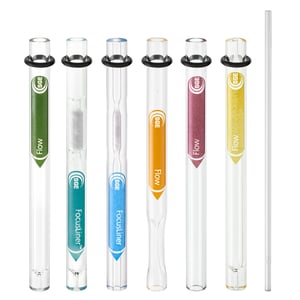
A GC inlet liner is typically a borosilicate glass tube providing a sample path through the injection port (inlet) to the GC column.
The inlet liner assists with sample vaporization by the inlet liner geometry and packing material increasing heated surface area; sample protection via chemically deactivated borosilicate glass; and column protection from non-volatile sample contaminants with inlet liner packing material such as quartz wool or glass frits, trapping non-volatile sample components and preventing them from entering the column.
SGE OptChem utilizes a unique thick-film deactivation, which is optimized for highly sensitive applications.
While self-installing quartz wool into an inlet liner, it is difficult to completely avoid breakage of the wool fibers. Broken fibers will increase chemically active sites within the inlet liner and can also scratch the interior surface of the inlet liner, causing further activity issues.
SGE inlet liners are deactivated after wool insertion to ensure any active sites exposed are rendered inert. This increases the reproducibility of the analysis.
Various geometry and quartz wool options in the SGE inlet liner range allows the user to select the optimal liner choice for their specific application.
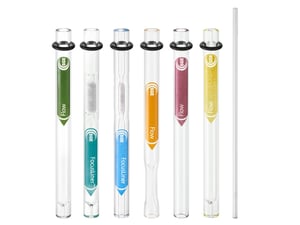
The SGE inlet liner range is color coded by geometry, making it easy to choose the inlet liner you need.
We do not recommend cleaning inlet liners. All liners manufactured by Trajan are deactivated and certified for high performance. During cleaning the deactivation will be removed.
Deactivating the cleaned liner in the laboratory will still result in the presence of active sites that can adsorb sample components and cause peak tailing, with potential loss of sensitivity and reproducibility.
Trajan recommends using an SGE inlet liner with wool to avoid unnecessary loss of high boiling point compounds. Many inlet liner designs include deactivated quartz wool packing, some of the reasons for this are:
- Provides additional surface area for complete volatilization of the sample to minimize sample discrimination.
- Traps non-volatile components and septum particles from reaching the column.
- Wipes any sample from the syringe needle, thereby increasing reproducibility and preventing sample residue build-up at the septum.
A wool-packed or fritted inlet liner can help increase GC column lifetime:
- Quartz wool or glass frits can assist in homogenization of evaporated analytes and solvent in the inlet. They also help transfer the analytes to the GC column entrance.
- Wool or glass frits act as a filter by blocking non-volatile impurities from entering the GC column.
The lifetime of inlet liners is difficult to predict, as it will vary greatly depending on the nature of the samples being introduced.
- If headspace injection is being used, only vapors will enter the GC inlet and the inlet liner can remain clean for months.
- If ‘dirty’ samples are injected, it may be necessary to inspect the inlet liner daily.
- In all cases, as soon as the inlet liner has residue visibly building up inside, it should be swapped for a new inlet liner.
Peak tailing can have several different causes, one of which is a dirty inlet liner, which increases active sites interacting with the injected sample as it is introduced to the GC column. If peak tailing persists, you may want to consider replacing ferrules, septa and o-rings, installing a guard column and/or using a different solvent for your analysis.
Please contact techsupport@trajanscimed.com for further information or advice.
The SGE OptChem taper inlet liner with glass frit and pre-fitted CRS ONE o-ring provides the same benefits as a bottom taper inlet liner with packed quartz wool, plus some additional advantages:
- The glass frit exhibits improved density distribution compared with woolpacked liners. Since the glass frit has a consistent porosity, the gas flow rate through the liner is more uniform compared to packed wool, which increases reproducibility.
- Using a frit removes any risk of wool breakage, which can expose active sites within the inlet liner and reduce the sensitivity of the analysis.
GC Ferrules
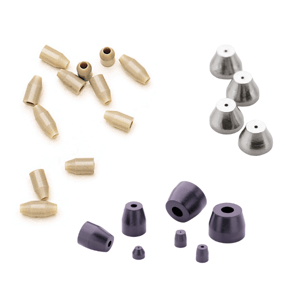
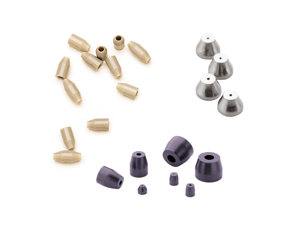
GC ferrules are available in graphite, Vespel®, Vespel-graphite and PTFE. View the full range of CRS GC ferrules.
The 400°C maximum is based on some oxygen being present. Above 400°C oxidation can start to occur. It can occur at lower temperatures if the ferrules are being used to seal a vacuum, as oxygen will be drawn in through the graphite. It may be possible to use them at 600°C without issues if oxygen has been excluded. Longer term there may still be some degradation.
SilTite
In-house testing has shown that it is possible to get SilTites to work with aluminium clad columns, but it is difficult to get them to work every time with a GCMS. If someone was not using MS, then if they are careful they should be able to get them to work.
Sometimes the aluminium layer can be a little rough, so it would be a good idea to avoid any sections of the column that feel rough. Since the SilTite material is relatively hard, when it is compressed down on to a rough area of the aluminium, it is more likely to cause a fracture.
The Agilent MS SilTite kit can be used. The ferrule fits with the point into the nut.
SilTite FingerTite
We have generally found that SilTite μ-unions do not work well with metal columns. This is due to two factors.
One reason is that the outside diameter of stainless steel capillary columns is generally different to fused silica column with the same inside diameter. SilTite μ-unions and ferrules rely on a very precise fit between the hole size and the outer diameter of the column. So when the outside diameter of the column is different, it is difficult to get a good seal.
The second reason is that the SilTite μ-unions and ferrules rely on the polyimide outer layer of fused silica columns being slightly soft, so that they can crimp (swage) slightly into this layer. Stainless steel capillary column tend to be too hard, and if they are not quit round or slightly rough, then the SilTite μ-unions and ferrules can not seal properly.
GC Septa
Yes, CRS Puresep T GC septa are faced with polyimide film, and have a double layer of polyimide and PTFE on one side.
Puresep T septa are not low-bleed septa, and their recommended maximum temperature is 225°C. Puresep T septa are stamped from sheets of material to the size specified. All general purpose septa are produced to tight tolerances in dedicated molds. View our full range of CRS GC septa.
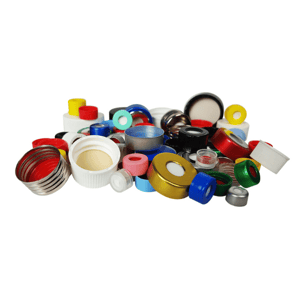
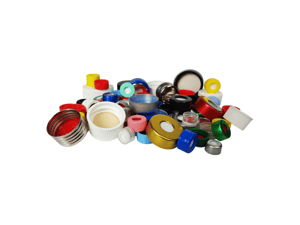
For other septa options for use with vials, including silicone with PTFE, view our septa, caps and liners range.
Phthalates are seldom present in silicone parts. There are no phthalates added to the septa during the manufacturing process.
| CRS GC septa | Trajan GC septa |
|---|---|
| BTO (Bleed temperature optimized) | HT |
| AG3 (Advanced Green 3) | EC |
| Marathon | MN |
| GP (General purpose) | GP |
| Puresep T | – |
| Endura-Seal | – |
View the full range of CRS GC septa.
- Filters “remove” one or two specific contaminants from a gas source such as removing oxygen from helium.
- Traps are considered to be the same as a filter.
- Purifiers “purify” a gas source from several contaminants such as purifying helium of oxygen, moisture, hydrocarbons, and other trace contaminants.
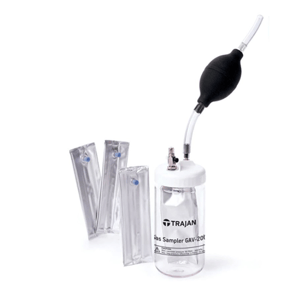
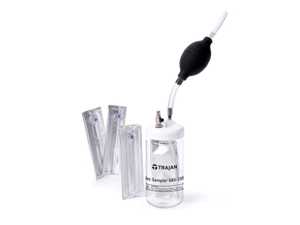
GAV-200
Ensure that the bag is not over inflated. Over inflation pushes the bag hard up against the walls of the canister, making it impossible to remove.
The sample bags are suitable for gas pressures differentials up to 5 psi.
Maximum temperature: 70°C
Minimum temperature: 5°C
Minimum operating temperature: 5°C
Micro Control Valves
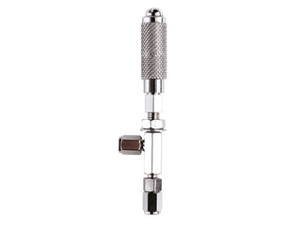
The internal volume of valve 1236091 in the open position is 12.57 μL.
The old seal has to be levered off. The new seal then has to be carefully levered on using something like a screwdriver, make sure that whatever is used doesn't have any sharp edges, or burrs, that might cut or tear the seal.
It may be tempting to use some detergent as a lubricant, but there is the risk that if any residue remains it may cause the valve to stick at a later stage.
GC Columns
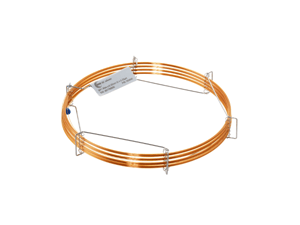
At temperatures above about 220/230°C It is believed that the hydrogen carrier gas will chemically reduce the BPX70 phase (the opposite of what normally happens when oxygen gets into a column). This can be seen as a collection of small peaks towards the end on the run (at high temperature). These can easily be mistaken for trace levels of some of the longer chain fatty acids. When using helium, the peaks are no longer seen. Therefore it is not recommend to use hydrogen as a carrier gas with BPX70 phases at high temperatures.
5 meters.